

Cherry Airlines © Pascal Sgro
AImagine - Photography and generative images
Exhibition curated by Delphine Dumont, Paul de La Marandais, Michel Poivert, Rodolphe de Spoelberch and Gabriela Torres Freyermuth
24 January — 15 June 2025
Do you want to know more about this exhibition? Join us for a guided tour!
“Who’s afraid of artificial intelligence? Photographers, perhaps—but not all of them! When it comes to AI, photography remains a model. The photorealistic quality of AI-generated images serves as a reminder that visual data production is fed by photographs stored in digital memories. Even if they no longer take pictures themselves, photographers can still create using the entities held in reserve. Beyond the folklore of hyperfakes (deepfakes), which AI-generated imagery is often reduced to, photographers explore the technology’s potential to imagine the world.” - Michel Poivert
The catalogue of the exhibition is available here.

(FR, 1991), lives and works in Martinique (FR).
Lineaments, 2024
Jordan Beal’s series blends art and technology to question colonial imagination and the rewriting of History. By photographing the computer screen while the AI is still in the process of generating the image, offering a still blurry image, he creates landscapes of paradoxical beauty, oscillating between dream and reality, while critiquing the static representations of Martinique. His work challenges what we see and the invisible mechanisms that shape our perception, with an aesthetic that is both captivating and unsettling.
-
Although artificial intelligence is an innovative tool, it relies on databases rooted in dominant narratives, thereby influencing how images are perceived. In attempting to depict a timeless Martinique, the images produced reveal layers of visual heritage, even when they aim to be groundbreaking. The notion of “non-history” that Jordan uses to describe Martinique highlights the ongoing erasure of the past.
Jordan Beal does not simply reproduce reality. He uses AI to create images that challenge existing representations. By combining it with Polaroid photography—often associated with authenticity—he blurs the boundaries between the artificial and the real. This choice results in images that, while familiar, diverge from usual visual expectations, suggesting places where time and history seem suspended.
Excerpt from a text by Eline Gourgues.

(FR, 1989), lives and works in Paris (FR).
Protomaton, 2024
Protomaton is an interactive artwork designed to explore and demystify the use of artificial intelligence by reimagining the photo booth for our era. The installation consists of a deconstructed computer and a camera that records on demand, offering three successive options that progressively transform the captured imagery based on different inputs: the exhibition environment, the subject positioned in front of the camera, and all movements or elements entering the frame.
-
The final prompt introduces a “dog bias,” interpreting all elements in a canine mode and fluidly transforming the subject into an animal. Through this work, François Bellabas investigates the creation of situations or experiences that induce perceptual shifts between coexisting realities, offering new hybrid perspectives.
Both playful and educational, Protomaton proposes a reimagining of the history of automatic portraiture, drawing from devices like Enjamber’s machine and the iconic Photomaton.

(FR/CH, 1976), lives and works in Vevey (CH).
D’après Ramuz, 2023-2024
Mathieu Bernard-Reymond draws inspiration from Charles-Ferdinand Ramuz, one of Switzerland’s most significant literary figures (1878–1947). Renowned for his evocative depictions of rural life in the Vaud region and his deep connection to the landscape, Ramuz’s works often explore the relationship between humanity and nature, characterized by a poetic language that captures the essence of the Swiss countryside.
-
Mathieu Bernard-Reymond brings to life the mental images that typically arise when reading a text, gradually transforming them into a visual reality that reflects a possible interpretation of the writing. The images were generated by blending textual excerpts from Ramuz with photographs taken by Bernard-Reymond in the Swiss Alps. His aim was to craft the visuals in a highly specific style, while embracing the poetic flaws inherent in these tools.
D’après Ramuz project seeks to bridge Ramuz’s literary legacy with contemporary technology, transforming his evocative descriptions into visual forms that encourage fresh interpretation and interaction with his work. D’après Ramuz is a work originally created for “La Muette, espaces littéraires” in Pully, Switzerland.

(BE, 1985), lives and works in Brussels (BE).
Real pictures, 1994-2024
In 2022, in response to the emergence of text-to-image generation models, Philippe Braquenier reflected on how these AI systems might interpret the descriptions from visual artist Alfredo Jaar’s installation Real Pictures (1995). Real Pictures consists of rectangular elements evoking the clean aesthetic of minimalist sculptures. However, each boxes that make up the installation contain a photograph taken by the artist, depicting various aspects of the Rwandan genocide—images that the viewer cannot see.
-
On each box, Alfredo Jaar described the image it contains, creating an installation that is part cemetery, part archive. To coun- ter the overwhelming anonymity of the victims, Jaar replaced the faceless mass with individuals, giving them names, identities, families, and connections, in an attempt to restore some of their humanity. Real Pictures project echoes Alfredo Jaar’s concerns about the quality of informa- tion and his feeling of being “bombarded by images.” It questions our perception of authenticity and the potential disruption of our interpretation of images in the age of artificial intelligence.
This project is not about the accuracy or role of these images but, given the relative novelty of this tool, explores a possible upheaval: the potential death of images as a reliable form of communication.

(DE/FR, 1986/1981), live and work in Paris (FR).
Une Histoire parallèle, 2022-2023
Une Histoire parallèle explores the impact of modern creative tools on photography, highlighting their ability to shape visual history and influence our perception of reality.
The artists assembled a selection of 250 photographs summarizing the history of the medium (style, techniques, periods), which they then translated into a series of prompts to query AI (MidJourney) in its first version from 2022. The algorithm generated outputs that uncannily resemble the original prints while incorporating errors that the artists deliberately preserved.
-
Une Histoire parallèle questions our memory of images—often iconic—and plays with nuances and inaccuracies that reveal the tool’s presence. The resulting album possesses a spectral quality, where we recognize the photographs yet detect anomalies that often expose underlying social stereotypes.

(USA, 1978), lives and works in Los Angeles (USA).
90 Miles, 2023
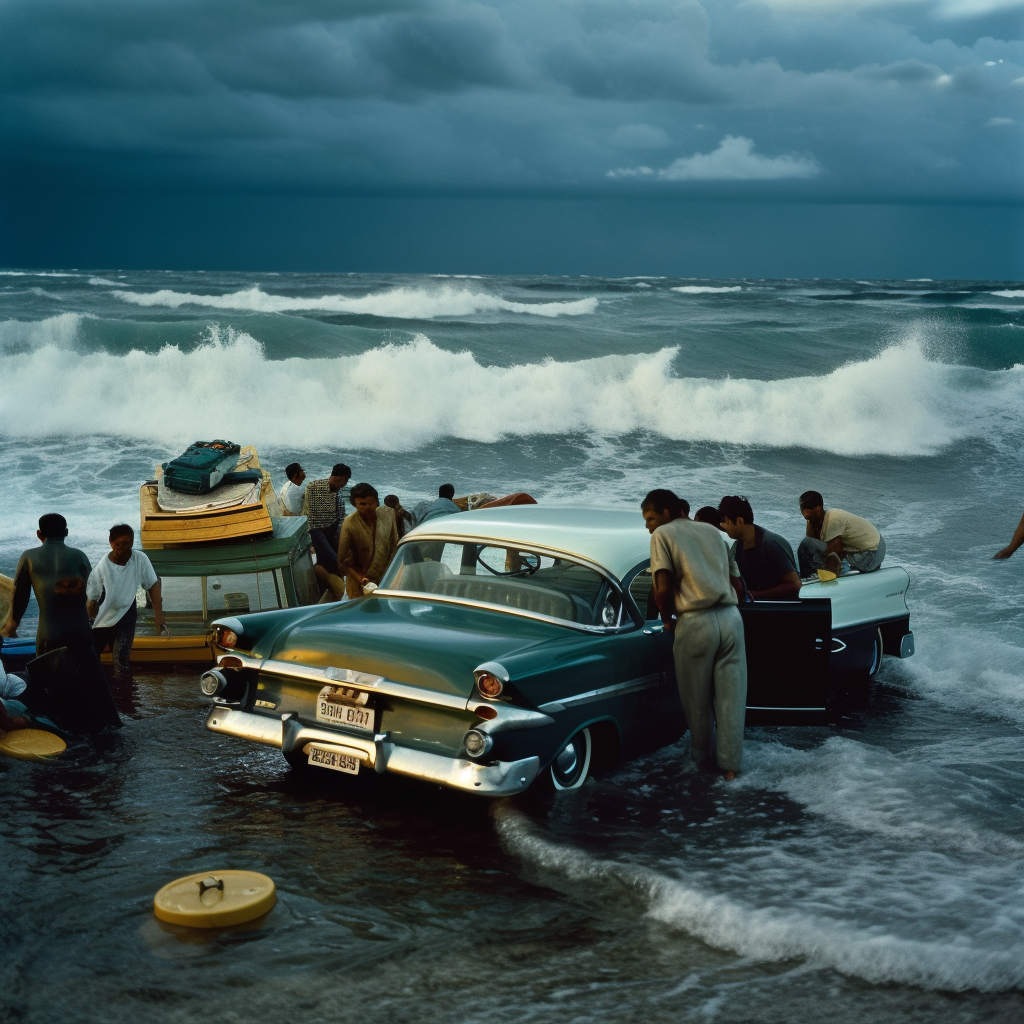
For over 25 years, photojournalist Michael Christopher Brown kept a list of subjects he could not address due to access difficulties or political danger. 90 Miles was one of these subjects and finally came to fruition in 2023 thanks to AI.
-
90 Miles explores the long-standing history of Cubans crossing the 90 miles of ocean between Havana and Florida, delving into why and how they do it. Michael Christopher Brown first discovered this drama on television and in the newspapers during his childhood in the United States. Between 2014 and 2016, while working in Cuba, he realized that documenting this story could endanger the lives of Cubans still on the island. Therefore, he collected data and testimonies from them, drawing on his own experience living in the country.
Based on real events, the collection of images spans from Fidel Castro’s rise to power in the late 1950s to the present day. Cuba’s economic crisis in 2022 and 2023 led to the largest exodus since the 1980s, with nearly half a million Cubans fleeing the country.
The AI-generated images were not retouched after their creation.
(FR, 1977), lives and works in New-York (USA).
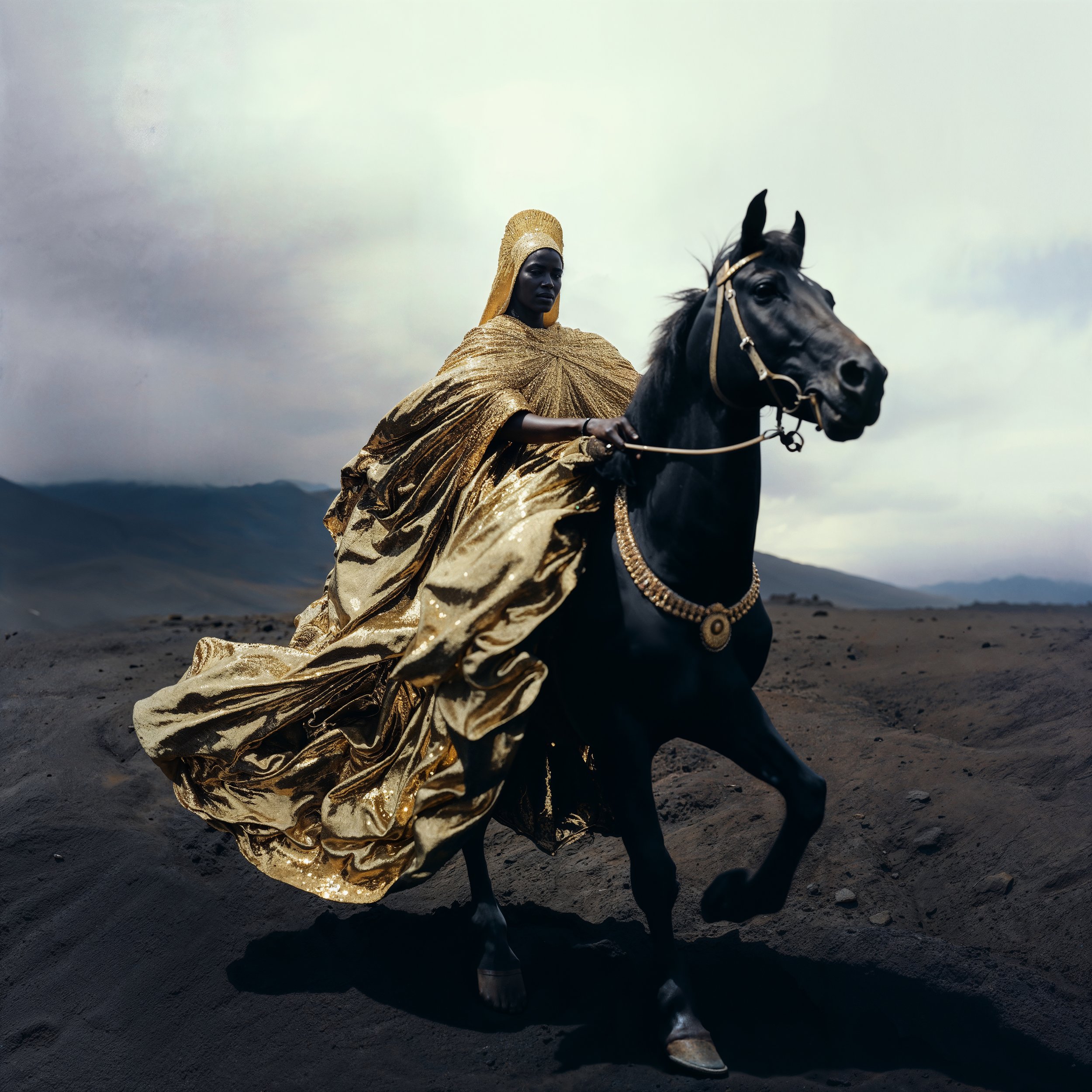
Kush, 2024
Delphine Diallo merges her passion for analog photography with the rising power of artificial intelligence, which she prefers to regard as a form of «ancestral intelligence.» Inspired by the Third Worldist thought of Frantz Fanon, the French psychiatrist and essayist (1925-1961), the artist presents a series of AI-generated images evoking vast landscapes from her travels in Africa. Her father’s Senegalese heritage and her mother’s French origin enrich her multicultural vision. Her work is rooted in the often-overlooked legacy of the Kushite civilization, an ancient kingdom in Eastern Africa.
-
Delphine Diallo creates a space where the real and the imagined meet, transforming artificial intelligence into a tool for cultural re-imagination. For her, decolonizing space means rehumanizing each individual by eliminating the objectification of Black bodies. Through this project, she envisions a harmonious future where ancestral intelligence and modern technologies complement each other.
(DE, 1984), lives and works in Berlin (DE).
New Farmer, 2024
New Farmer presents itself as a collection of documentary photographs from the 1960s, seemingly tracing the flawless trajectory of the Green Revolution: genetic manipulation leading to new crop varieties, resulting in more abundant and higher-quality harvests. However, cracks begin to appear. The images, while convincing, are actually AI-generated, and the narrative is entirely fabricated: it does not culminate in vast monoculture fields but with giant vegetables.
-
Blending humor and absurdity, New Farmer explores how images shape and observe history, while questioning the dominant narrative of the Green Revolution. The project examines our extractivist relationship with nature and invites the audience to reflect on their place in the biosphere and the repercussions of their actions.

(FR, 1985), lives and works in Paris (FR).
Prelude to the Broken RAM, 2022-2023
Prelude to the Broken RAM is an experimental artist’s book created in 2022, at a time when generative artificial intelligence was about to revolutionize visual creation. This work explores the cyclicality of technological advancements and their impact on art, weaving connections between four key dates:
1827: Nicéphore Niépce captures the first recognized photograph.
1917: Marcel Duchamp revolutionizes art with his ready-made Fountain.
1997: IBM’s Deep Blue defeats Kasparov, marking the superiority of AI.
2027: A future anticipating the next AI revolutions.
-
Prelude to the Broken RAM refers to Marcel Duchamp’s 1915 sculpture In Advance of the Broken Arm and plays on the term «RAM» (Random Access Memory), a core component of computing. This work draws parallels between photography, ready-mades, chess, and artificial intelligence.
David Fathi invokes the thinking of Marcel Duchamp as a spectral figure central to his work, with Duchamp’s influence permeating and resonating throughout contemporary discourse on art. Prelude to the Broken RAM is both a product and a commentary on its time, experimenting with the limits of what was technologically possible in 2022—already vastly improved from the «ancient» 2021, and soon to be outdated in the futuristic 2025.

(FR/PL, 1975), lives and works in Warsaw (PL).
Giant Inscrutable Matrices, 2024
Giant Inscrutable Matrices is a term coined by Eliezer Yudkowsky (USA, 1979), writer and blogger, to describe artificial intelligence. It refers to its massive servers (Giant), its opacity—even to its creators (Inscrutable), and its complex data structures (Matrices). A fierce critic of AI, Yudkowsky warns that AI could annihilate humanity once it reaches a sufficient level of intelligence.
-
Nicolas Grospierre visually explores this concept, drawing inspiration from his collection of vintage negatives depicting circuit boards—seen as precursors to AI—and creating a sculpture evoking the vast and complex presence of AI. He also used AI (via Midjourney) to generate striking images of shimmering monoliths in barren landscapes, representing a post-human world dominated by AI. With Giant Inscrutable Matrices, Nicolas Grospierre captures both the fascination and existential dread that artificial intelligence evokes.

(FR, 1982), lives and works in Metz (FR).
Impression, soleil levant, 2024
One day, at a flea market, Isidore Hibou bought an old photo album from which all the images had been removed. Only the captions, written in pencil and still legible, remained, inviting the imagination to fill in the missing photos. Through other handwritten information, he discovered the name of the album’s owner, a certain General Preau (20-21st North African Infantry Regiment, 1926).
-
Isidore Hibou pondered these ghostly memories from countries like Syria and Lebanon, whose current events still resonate today. The captions seemed like so many «prompts» to submit to AI in order to bring the album back to life, offering it a new visual coherence. Impression, soleil levant draws inspiration from Monet’s famous painting, establishing a parallel between the Impressionist revolution and artificial intelligence. It is no longer about faithfully representing reality, but about offering a ne interpretation, reviving images that blend daydream and reality, past and present.

(CH, 1952), lives and works in Zug (CH).
Silfio, 2023
Silphium is recognized as the first plant species whose extinction is documented in writing. Cyrene, a Greek colony later absorbed into the Roman Empire, based its economy on the trade of silphium, making it a symbol of the city, often depicted on coins dating back to the late 6th century BCE. Despite its great value, both as food and medicine, the plant disappeared without a trace after only a century.
-
The prevailing theory for its extinction is intensive use and overexploitation by colonizers, without proper resource management. The series Silfio presents digital collages of fictional flowers extracted from the archives of the Château de Fontainebleau, interwoven with AI-generated images of extinct plants. The AI application generated unrealistic images, distorting reality and creating a sense of disorientation.

(BR, 1955), lives and works in Rio de Janeiro (BR).
Bárbaras, 2024
The starting point for this project was the story of Bárbara de Alencar, an 18th-century Brazilian woman, one of the leaders of the Pernambuco Revolution of 1817. Bárbaras results from extensive historical, iconographic, and photographic research into women who played important roles in Brazilian history but are often overlooked or forgotten.
-
The portraits of these women, represented as «Stamps,» are tributes, created through a collage of drawings, paintings, sculptures, and fictional elements, including the use of AI. The «Postcards» depict places that hold traces of their lives. The choice of «Stamps» and «Postcards» as formats symbolizes the idea of circulation and the recovery of memory, ensuring that the contributions of these women continue to resonate in today’s world.

(FR, 1990), lives and works in Arles (FR).
New New York, 2024
New New York consists of photographs recreated using period techniques such as collodion and silver printing, presented in a display inspired by the Armory Show—the groundbreaking international modern art exhibition held in New York in 1913. This approach offers a free and anachronistic reimagining of the history of photography in New York. In this project, Robin Lopvet takes on the role of an archaeologist, blurring the boundaries between reality and fiction while questioning the very nature of photography.
-
The series also includes New New York, an animated video created by Robin Lopvet in collaboration with Mathieu Blanc-Francard, alias Sinclair. This piece revisits the history of photography in New York across the 20th and 21st centuries. Through frame-by-frame editing and the use of AI, the video immerses viewers in a dynamic visual and sonic whirlwind, offering a subtle critique of the continuous flow of information while maintaining a poetic and humorous tone.

(RU, 1994), lives and works in Florence (IT).
ANIMA, 2024
Inspired by Donna J. Haraway’s Cyborg Manifesto, a feminist essay published in 1984, the ANIMA project explores the concept of the cyborg as a symbol of changing, complex, and evolving identities. Alisa Martynova, with the help of scientist Filippo Carnovalini who created a custom AI program (Artificial Intelligence Lab, Brussels), accessed a hidden space where the machine «dreams» of the images it has seen and processed. This reinterpretation of an archive, created over several years, transforms abandoned images from the past into a living and collaborative creation.
-
These AI-generated images blur the line between the past and the present, leading to the fantasy of the Generation of Self. For the artist, cyborgs represent modern hydras—symbols of hybrid identities free to choose who they wish to become.
The ANIMA project was partially developed during a residency at Hangar in September 2024. This work was produced with the financial assistance of the European Union. The views expressed here can in no way be taken to reflect the official opinion of the European Union.

(BE, 1997), lives and works in Brussels (BE).
Cherry Airlines, 2024
In this photographic project, Pascal Sgro revisits the 1950s through the creation of a fictional airline: Cherry Airlines. During this era, air travel symbolized progress and elegance, and Sgro reimagines this period through nostalgia and fiction. Each image is recreated using AI, blurring the boundary between reality and invention. Cherry Airlines reflects contemporary society, where the pursuit of luxury comes at the expense of the planet.
-
Since the 1950s, the quest for comfort has fueled the climate crisis, with aviation playing a central role. By juxtaposing the idealized luxury of air travel with current environmental realities, the project highlights the paradoxes of consumer culture. Through Cherry Airlines, Pascal Sgro invites reflection on the contrast between past ideals and today’s ecological challenges. The vintage aesthetic and digital manipulations create a world that critiques contemporary values and the environmental cost of our lifestyles.

(FR, 1986), lives and works in Nouvelle-Aquitaine (FR).
The Progress, 2023
The Progress explores the intersection of photography and painting through the lens of artificial intelligence. By revisiting the aesthetic codes of the Baroque period and genre scenes, this series contrasts these elements with a post-COVID youth, depicting a fantastical and disenchanted reality.
-
The Progress highlights the accidental imperfections of generative images, which emerge as essential and revealing components, paying homage to the early explorations of photography. Far from being concealed, AI errors are celebrated as creative elements, evoking the flaws and challenges of generative creation. The series questions the pursuit of perfection and offers a reflection on the authenticity of the image at a time when technology is redefining artistic practices.

(RU, 1986) lives and works in New York (USA).
Silent Hero, 2019
To fill the void left by his grandfather’s passing, Alexey Yurenev embarks on a journey through history, spaces, and time to renegotiate the narrative of his ancestor’s wartime experience. By combining machine learning, family photographs, archives, interviews with Red Army veterans, and forensic research, Silent Hero explores how these methods shape knowledge and memory.
-
Alexey Yurenev knew his grandfather was a war hero, but he questioned what that truly meant. In search of traces of his past, he delved into archives and family albums, where the war was captured in studio portraits, detached from reality. AI became a tool to bridge the gaps in the archive, generating images that convey psychological narratives rather than direct testimonies. By training a model on 35,000 images of World War II, the machine produced depictions of war stripped of glory, offering new interpretations through fabricated yet arguably realistic representations of conflict.


Our current exhibition views
©TAVU
