
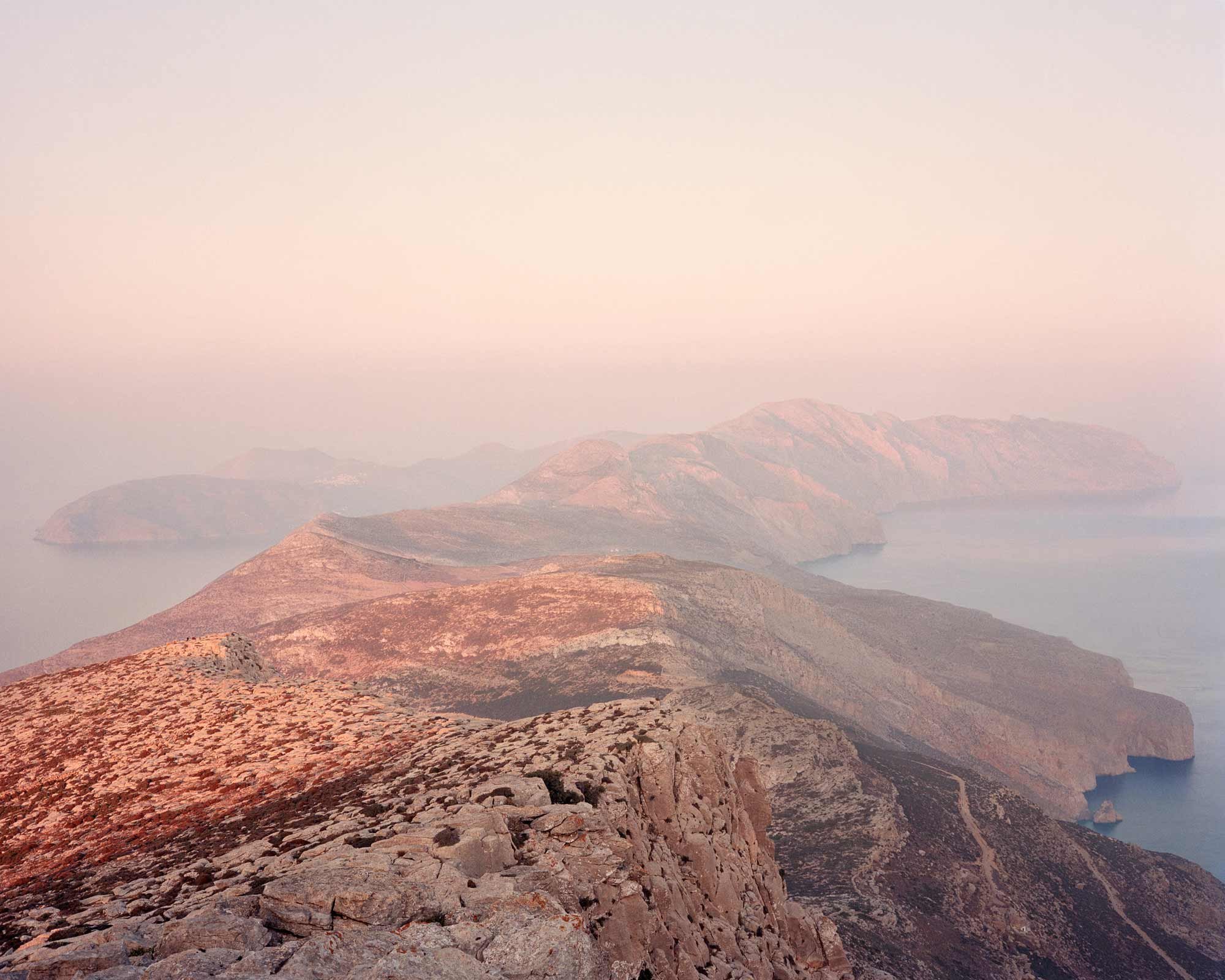
From the series Les Rochers fauves, 2019 © Clément Chapillon
Melting Islands
The inherent fragility of islands is a complex issue that is influenced by a range of environmental, economic and social factors. The melting of populations, ice and sandy coastlines pose a significant threat to the sustainability and resilience of island communities and ecosystems, be they tropical or Arctic. With Melting Islands, Hangar presents 4 projects that illustrate some of these challenges:
The melting of permafrost on islands leads to significant changes in the landscape and ecosystems. Frozen grounds constitute a crucial part of the global climate system. As they thaw, they release large amounts of carbon dioxide and methane, powerful greenhouse gases that contribute to global warming. Matthieu Litt's timeless images plunge us into a poetic contemplation while keeping us aware of the threat to these landscapes.
The extraction of sand from the coastline has negative consequences for the environment as well as for human communities. In Cape Verde, Mathias Depardon alerts us to the double scourge of erosion and loss of biodiversity on the one hand, and of great poverty and human exploitation on the other.
Island communities are often considered fragile because of their isolation on every front. La Firme of Richard Pak focuses on a community at the 'end of the world' with unique cultural and social characteristics. With Les rochers Fauves, Clément Chapillon plunges us into the arid world of Greece's least populated island.
19 April — 8 July 2023
(FR, 1982), lives and works in Vauvenargues (FR).
Les Rochers Fauves is Clément Chapillon's latest series. It takes place in Amorgos, the easternmost island of the Cyclades archipelago, which is also the poorest and least populated of Greece. In this concurrently documentary and metaphorical narrative in images, he questions the notion of insularity and the ensuing isolation, while exposing the ambivalent feelings it engenders. He also has his medium-format analogue images enter in dialogue with one of the first writings on this island, La Grèce d'aujourd'hui by the archaeologist Gaston Deschamps (1880).
-
Clément Chapillon discovered the island of Amorgos about fifteen years ago. He has stayed there several times and it has become almost an obsession. In photographing this arid, rocky and wild territory, with its preserved traditions, he put into images the feeling of disquieting strangeness that it stirs in him.
Exhibited several times in France and published in 2022, this series, part of Melting Islands exhibition, earned him the Fondation des Treilles prize in 2019.

(FR, 1980), lives and works in Paris (FR).
In his series Moving sand, Mathias Depardon focuses on the second most consumed natural resource in the world after water, the sand. Produced in collaboration with Le Monde’s Planet Service, this documentary explores the issue of sand overconsumption, from its massive extraction and its consequences on the environment, to its impact on local populations. It reports on these issues in six geographical areas: India, the Maldives, Florida, Cape Verde, and Paris.
-
In Cape Verde, women have been extracting sand, an illegal but tolerated activity, for several generations. Known as «sand scavengers», these women, often alone with dependent children, collect sand with shovels and buckets. Although most of them do not know how to swim, they now extract sand directly in the water, a practice that has led to the destruction of the region’s beaches and coastline. At the same time, there has been an increase in the salinisation of the land, which damages crops and plantations. Entrusted to the poorest segments of the population, this back-breaking work is also the starting point of a local black market in building and construction, motivated by the real estate boom in this highly touristic area since the 1970s.

(BE, 1983), lives and works in Liège (BE).
With Terra Nullius, Matthieu Litt focuses on the wild and inhospitable territory of the Arctic world. He made this series in Greenland as part of the «Artistes en Arctique» residency on board the Manguier (2019). Terra Nullius was the name given to the undiscovered lands, places where everything was possible, and areas highly attractive to navigators and explorers. The images are superimposed, as are the magic of the place, the attraction felt by the photographer, and his sadness at feeling that he is witnessing irreversible changes. The mixture of images reflects the emotions and perceptions - and imperceptibly, the sweetness sometimes melts into a tenacious melancholy...

(FR, 1972), lives and works in Paris (FR).
La Firme series is the first chapter of the “Les îles du désir” anthology, dedicated to island space, in which Richard Pak examines the identity and singular history of the British island of Tristan da Cunha in the South Atlantic. Considered the most isolated on the planet, this inhabited territory was founded by a group calling themselves ‘the Firm’ in the contract they signed with the British Crown in 1816.
-
The foundations of this new society are based on idealistic principles of equality and sharing. For example, the island is not ruled by a chief, money does not exist, nor does private property, as the founding contract for instance states that «all profits made shall be shared equally». At the end of 2016, Richard Pak spent three months in Tristan da Cunha, having obtained permission to go there from the island’s council, and set out on the trail of a utopian society. For Melting Islands, he reconstructs the still palpable legacy of this society by combining photography, video and narrative with historical documents from collections such as the British Library, the Royal Geographical Society and the Bibliothèque Nationale de France.
