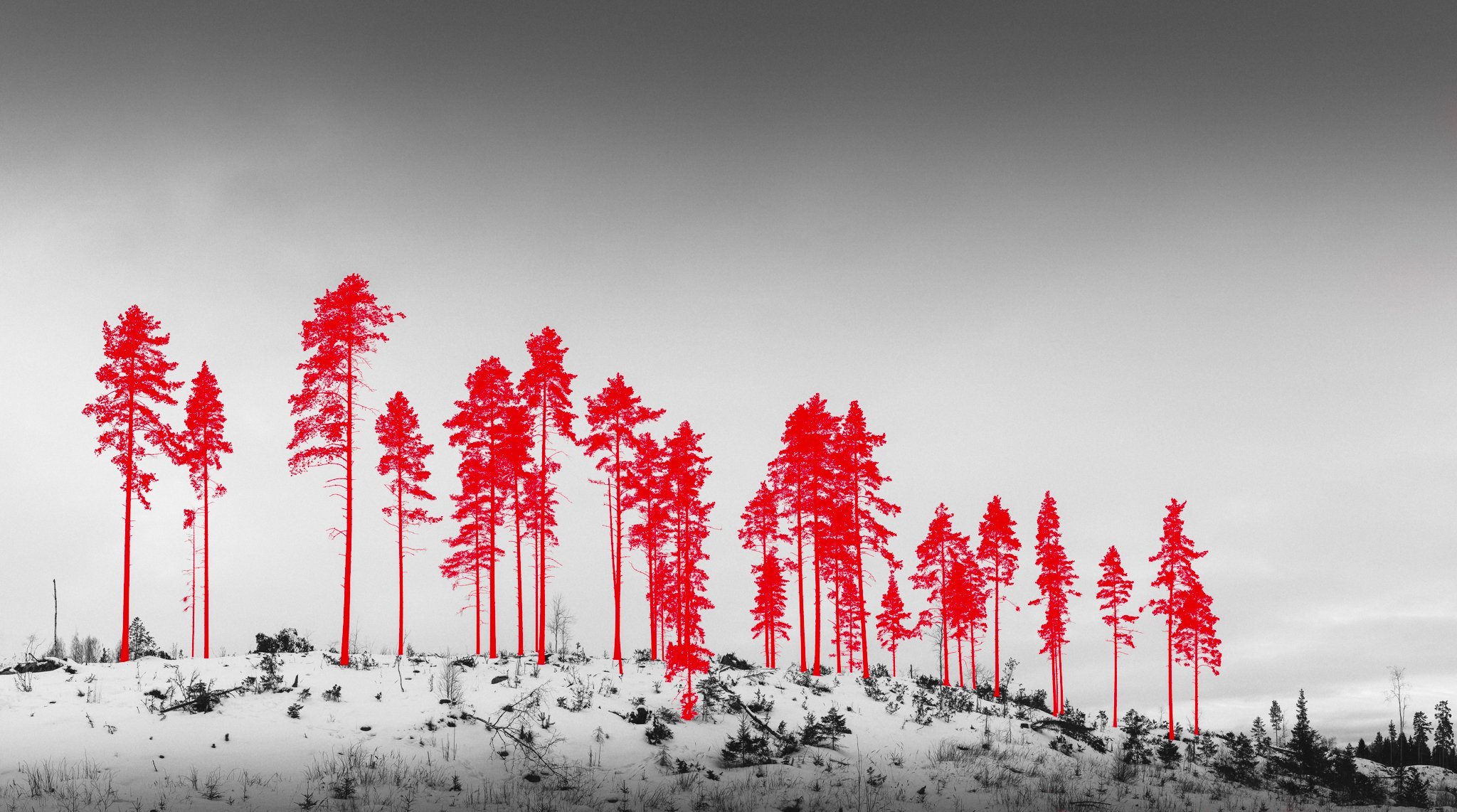
100 Hectares Next Possible Victims, 2018
In the Shadow of Trees
Photo Brussels Festival
21 January — 26 March 2022
Hangar proposes, in the context of PhotoBrussels Festival 06, a large exhibition: In the Shadow of Trees. The exhibition brings together twenty photographic projects (including the three winners of the Prize*).
Standing alone in the landscape, or surrounded by or competing with its peers in the forest, forming a distant or close part of human activities, the tree is a highly pertinent subject in contemporary photography. The variations of forms and light that the tree expresses so well, in essence, the raw materials of photography, did not escape the pioneers of this medium in the 19th century either. Throughout the history of art, the tree has been used as an explicit symbol of life, growth, seasonal death, and resilience.
While the tree, the world’s largest living organism, sometimes surviving for thousands of years, is often the emblem of a particular region or culture, it is also a state of mind. The images revealed by the lens make it possible to gain an idea of the artist’s character and emotions. It is precisely that extraordinary diversity that the Hangar aims to reflect through In the Shadow of Trees, an exhibition that brings together twenty or so photographic projects. The show also aims to shine a light on the crucial place that trees occupy in life and the influence they have on the survival of humankind. Indeed, in 2022 we can no longer ignore the ecological and environmental underlying all artistic work.
On the one hand, In the Shadow of Trees invites us to capture the flow of energy that emanates from these artistic projects and the way in which they affect our mood, attitude, and desires. While on the other, the exhibition calls on us to become aware that every individual on this planet Earth, lives in some way in the shadow of trees…To this Hangar curation are added the three winners of the call for projects, the Prize*.

(NO, 1978), lives and works in Oslo (NO).
Slash & Burn, 2017
With Slash & Burn, Terje Abusdal meets the Forest Finns, who are recognized as a national minority in Norway. The Forest Finns lived in Finland, in a region close to Russia, and practiced slash and burn agriculture. This ancient farming method required the people to move to another area of land once the natural resources were exhausted.
-
In around 1600, the need for new land to cultivate caused the migration of the Forest Finns. They then occupied a vast belt of forest situated along the frontier between Norway and Sweden, an area still called the Finnskogen (the forest of the Finns). Today, the fires they lit have long since been extinguished and the culture of the Forest Finns no longer exists as such. The understanding of nature they brought was rooted in an eastern shamanistic tradition, and even today they are often associated with magic and mystery. The Slash & Burn project is based on these beliefs while examining what it means to be a Forest Finn today. This series of photographs includes “symbolic” images from the territory of the Forest Finns, as well as portraits of members of the community.

(UY, 1990), lives and works between Montevideo (UY) and Sao Paulo (BR).
Seeds of Resistance, since 2018
“They think that the solution is to bury us, but what they haven’t realized is that we are seeds”. Seeds of Resistance aims to highlight the powerful link that binds people to the territory they live in, in this instance the Amazonian forest, whose integrity they defend with tenacity.
-
In 2017, 201 defenders of the environment lost their lives trying to protect their land from the ravages of mining and agri-business. According to the experts, the majority of these deaths occurred in South America. In Brazil, 57 people were killed – 80% of them while defending the Amazon rainforest. Faced with an alarming ecological situation, the traditional communities of South America continue to defend their land. The many industrial projects in progress are draining the region’s natural resources, without taking any account of its history or culture. Traditional populations, tied to the sacred land of their ancestors, refuse to abandon their territory, even after it has been extensive destroyed. Pablo Albarenga is a visual storyteller whose focus is primarily on telling social stories and environmental justice. Seeds of Resistance features 14 portraits of men and women, indigenous and/or activists, who are deeply committed to defending the Amazon forest. Through the individual paths they have taken, they are both symbols and mouthpieces for what has become a necessary resistance movement.

(FR/MA, 1979), lives and works in Tours (FR)
Résurgence, 2010 – 2015
Basing himself on the motif of the tree as an element of our collective memory, in Résurgence, Mustapha Azeroual examines old photographic processes that are the very origin of the medium. The principle of image composition calls for the hybridisation of photographic techniques.
-
Mustapha Azeroual combines the old process of gum dichromate with that of digitisation. Chamber photography, the digitisation of silvered negatives and the superimposition of films give rise to the duplication of images and a framing of the image organised around a point where the trunks of the trees intersect with the horizon. The process of gelatine applied to blank paper, getting the dosage of the mixture of gum Arabic, dichromate and pigments just right and the gesture of the brush are all steps that are not mechanised and which stem from the photographer’s choice and his assurance of the way he operates. His work is based on observation and experimentation, contrasting historical techniques with the contemporary issues of photography. Résurgence is a series of images printed on paper and porcelain. (Information taken from a piece by Jérôme Duvignau)

(DE, 1959), lives and works in Bad Tölz (DE).
Reading the Landscape, 2008-2014
Reading the Landscape tackles the worldwide issue of deforestation and examines our ability to understand and rethink the way we look at nature. Over the past 30 years, almost 90% of the forests in Indonesia have been destroyed and replaced by monoculture.
-
Reading the Landscape is a photographic project and book that document, in three sections (habitat I, habitat II and habitat III) the three states of nature that exist in the primary forests of Indonesia and Malaysia: intact nature, ravaged nature and artificial nature. In this final section, Olaf Otto Becker draws our attention to the lack of vegetation in big towns and cities, and our watered-down use of trees to try and remedy the situation. This latter point also demonstrates how humans could lose their connection with nature – a link that is required in particular to “decorate” our urban landscape. At the same time, we are creating a version of the forest that matches our own imagination and transforms plants into a “commodity” that constantly needs renewing. Reading the Landscape reflects a fatal ecological and economic process that has gone beyond the point of no return.

Jelle Brandt Corstius & Jeroen Toirkens
(NL, 1978 / NL, 1971)
Borealis, 2016 – 2020
The boreal forest (from the Latin: borealis) or taiga (of Russian origin) forms an almost uninterrupted ring in the regions to the south of the Arctic. Made up mainly of conifers, the boreal forest extends across Europe, Asia and North America. It represents 30% of the world’s wooded area.
-
Taiga is of inestimable value as an enormous reservoir of carbon. The forests, peatlands and marshes that make up the taiga, store 44% of the carbon from all plant life on Earth. These carbon “sinks” are important because they absorb the carbon that is not found in the atmosphere in the form of CO2. Over a period of four years, the photographer Jeroen Toirkens and the journalist Jelle Brandt Corstius have produced a major documentary project about the people who live in these boreal forests through eight stories covering six countries. Who lives there? How do they live? And what is the relationship between the forest and the people who live there? As the effects of climate change become felt more and more, especially in the far North, these testimonials provide invaluable historical documentation.

Persijn Broersen & Margit Lukács
(NL, 1974 / NL, 1973), live and work in Amsterdam (BE).
Forest on Location, film 2018
In Forest on Location, Persijn Broersen and Margit Lukács use the backdrop of one of the last remaining primary forests in Europe, Białowieża, located between Poland and Belarus. This unspoilt natural area, still unexploited by humans, is the last vestige of a forest that covered a significant part of Western Europe long ago.
-
The Polish nobility saw this forest as a place to enjoy hunting, as well as a location steeped in mythology. Unlike estate and regulated forests, Bialowieza was protected and has remained wild. To depict Białowieża, Persijn Broersen and Margit Lukacs created a virtual model using a technique called photogrammetry, which enabled them to copy elements of the forest in three dimensions by bringing them all together from different angles. In the video, this virtual forest is used as the setting for a performance by the Iranian opera singer Sharam Yazdani. Working with Broersen and Lukacs, the singer has created a reinterpretation of “Nature Boy”, a highly popular hit by Nat King Cole, and “Be Still My Heart”, his Yiddish version written by Herman Yablokoff. Yablokoff is an American Jewish composer of Belarusian origin, a star of Yiddish theatre and himself a native of the Białowieża forest. His melancholic song tells the story of a Russian immigrant leaving for New York, where the striking contrast with the memory of the wild natural surroundings of his childhood becomes too much for him to bear.

(CA, 1955), lives and works in à Toronto (CAN).
Natural Order, 2020
In the spring of 2020, Edward Burtynsky found himself in lockdown in Ontario (CA), due to the coronavirus pandemic. More accustomed to travelling across the continents, the photographer grabbed this isolation as an opportunity to focus his lens on the landscapes around him. The result is this new series of images, Natural Order, produced during the time of the year when the earth is blossoming and in the process of being reborn.
-
From the icy slumber of winter to the fertile urgency of the spring, these pictures are an affirmation of the complexity, marvel and resilience of the natural order in all things. Burtynsky finds himself contemplating a myriad of apparent chaos, but from this selective contemplation, order emerges – a long-lasting order that remains intact whatever our own human destiny may be. These pictures were all taken in a place called Grey County, in Ontario. “They also come from a place in my mind that aspires to create order from chaos and to act as a soothing balm in these uncertain times,” explains Edward Burtynsky.

(US, 1952)
New York Arbor, 2011-2012
These three monumental photographs are part of a series made up of 42 images called New York Arbor. The large trees photographed by the artist, whether wild or growing under control and cropped with care, are a living memoire of the city of New York, a testimony to the symbiotic relationship that connects the people who live in this city to their trees.
-
Like Eugène Atget, who at the beginning of the 20th century photographed the trees in Paris, Mitch Epstein individualises the plant element of his subjects, emphasising its exceptional character. Many of these trees, now grown to majestic proportions, arrived in New York as souvenirs or diplomatic gifts. Despite the advance of the urban sprawl that has slowly closed in on them, they continue to flourish. New York, a welcoming but tough city, is characterised by its huge diversity of populations whose origins date back to the heyday of immigration. These portraits of trees are both metaphors and monuments. Featured in the foreground, extracted from the backdrop of the city, the trees photographed appear like actors in urban life, in New York, city of trees. “By photographing the trees of the city, I began viewing it as a forest, with society and the architecture gradually eclipsed by nature. I developed a different perception of the urban space, which is usually seen as revolving round humans, and the trees became the main characters of the city.” (Mitch Epstein). For me, this is a hymn to life, to hope, to the grandeur of time that passes and an ode in black and white to nature. - Astrid Ullens de Schooten Whettnall, President of Fondation A.

(ES, 1979 / CH, 1981)
AYA, 2016-2019
The departure point for the Aya (“phantom” or “soul” in Quechua) project was an old postcard sent by Arguiñe Escandón to Yann Gross. The card features a man, Charles Kroehle, photographer and explorer at the end of the 19th century, surrounded by Amazonian natives, posing proudly alongside a dead crocodile. Fascinated and haunted by the ghost of this adventurer, Arguiñe Escandón and Yann Gross decided to head for Peru to “get rid of these images of Eldorado, conquistadors, and savages, good or bad” (A. Robert).
-
Setting out in the footsteps of the adventurer, the two artists “track down the specters of their own civilization, but also of their discipline”, pushing their research into the essence of the Amazon as far as producing their photos using the juices of plants with photosensitive properties. Aya illustrates the impact that depictions of Amazonia a century ago have today. “Whereas on the postcard the subjects were posing without a second thought by the remains of a crocodile, these days even the most anodyne images (a spider’s web, a snake being held, or a section of forest) are plagued by a feeling of loss foretold. Amazonia is disappearing. And Aya heralds its survival in the mind.”

(FR, 1970 – 2021), divided his time between South America and Africa from 1990 to 2000.
Paradis perdu, 2017-2021
Paradis perdu is a photographic project that Eric Guglielmi produced in the Congo basin (Cameroon, RDC, Congo, Central African Republic, Gabon, Equatorial Guinea). The forest of this region is a major carbon reservoir, the planet’s second-largest green lung (over 600 million acres) and the victim of intensive deforestation, caused mainly by farming, palm oil operations and the trade in precious timber.
-
The photographer set off to meet the Bakas in the East, who live from natural resources alone. Fascinated in particular by the red earth (concentrated in iron oxide), Guglielmi returned years later and produced a number of platinum-palladium prints, the main component of which is an emulsion of iron oxide. The entire series is produced using traditional photography, with orthochromatic film sensitive to green and blue, but not to red. This gives the earth a ghostly appearance and the richness of the greys reinforces the presence of the trees.
“His art interrogates the blind spots of media attention and plays with stereotypes.” (Zoé Haller)

(DK, 1970), lives and works in Copenhagen (DK).
Old Tjikko, 2016
Old Tjikko has been given a new lease of life through the work of Nicolai Howalt. It was while travelling in the national park of Fulufjället in Dalecarlie (Sweden) that Nicolai Howalt took a series of photos of this spruce tree, the roots of which have been dated by carbon 14 to be 9550 years old.
-
It is one of the oldest clonal trees in the world (trees that have trunks with a shared root system). The Old Tjikko series was developed on several different types of old paper, some of which date back to the 1940s. The structure, construction and origin of the paper combine to make Old Tjikko appear via a range of aesthetic variations. The material itself – paper – almost takes precedence over artistic expression. Through the image of Old Tjikko and these vintage papers, both of which bear marks from the past, Nicolai Howalt offers us a particular vision of time that passes.

(1954, KR), lives and works in Seoul (KR).
Street of Broken Hearts, 2008 - 2017
Street of Broken Hearts draws the viewer into what appears to be a vast forest covered in simple trees, such as stoic individuals that are both flexible yet firmly rooted. No one could guess their era or where they come from. In fact, these photographs depict trees planted in rows, in an alley in Seoul (Korea).
-
Totally forgotten, even neglected, some of the trees are broken, dislocated, by the local people or the wind. The only person who sees them is the artist, who brings them out into the light by photographing them in a fragmented way. Street of Broken Hearts is a series of 54 large-format photographs, printed on Korean rice paper.

(FI, 1989), lives and works in Helsinki (FI).
100 Hectares of Understanding, 2015 – 2020
In 1997, Jaakko Kahilaniemi inherited a forest in Finland of 100 hectares. At first unexcited by the idea of owning such a property, it was through producing the artistic project called 100 Hectares of Understanding that he discovered the world of silviculture.
-
Little by little he began to understand what a forest and its various stages of life can mean: planting, natural regeneration, harvesting the trees, etc. Through the testimony of his encounter with his forest and by taking a fun and open approach, a little like the “walking artist” Hamish Fultons, Kahilaniemi tries to create new ways of thinking, experiencing and feeling the forest. 100 Hectares of Understanding is made up of lost and found objects, photographed gestures, sculptures and small rituals personal to the artist. Jaakko Kahilaniemi decomposes, dissects, picks apart and offers his forest up to be viewed in a mysterious and secret atmosphere.

(FR, 1955), lives and works in Paris (FR).
Baobabs citernes, 2019
Baobabs citernes is a photo-reportage work devoted to the amazing use of a thousand of these trees as water tanks. In the south-west of Madagascar, not a single drop of rain falls for 9 months. There’s no surface water, no lakes, no rivers. 20 000 ethnic Mahafaly and Antandroy people live in this hostile environment.
-
After a dreadful drought, lasting between 1920 and 1930, which killed thousands of people, finding ways to store water became crucial for the population. Some people had noticed that when baobabs were struck by lightning and the trunks split, the water in the hollow of the trunk was preserved without going bad and also the tree did not rot. So the local inhabitants decided to turn them into water tanks. A large trunk can store up to 14000 litres of water and once dug out, the tree forms new internal bark, which allows it to continue living while storing water at the same time. Since this discovery was made, 800 families owe their survival to the water retained in these trees. Every baobab is like a genuine water safe. Today, with recurrent droughts linked to climate change and galloping demographic growth, managing water is more than ever a life-and-death issue for local populations.

(US, 1956), lives and works in San Francisco (US).
Ancient Trees, 1999 – 2013
“The pictures of Beth Moon capture the power and mystery of the last ancient trees in the world. These venerable sentinels of the forest are among the oldest living things on the planet and it is of the utmost importance that we do everything in our power to ensure their survival.” - Jane Goodall
-
For 14 years, Beth crisscrossed the world in search of its oldest and most ancient trees. The time that she spent contemplating them turned into quiet introspection and as a result of looking at the trunks of trees sometimes as old as 2000 years, witnesses to our geological history, Beth came face to face with her own fleeting existence. The artist captures the beauty and power exuded by these trees in connecting us with the concept of time. Presented here as a gallery of portraits, these individuals belong not so much to the past, but they continue the tenuous existence as part of our civilisation. Choosing the best season, camping at the foot of the trees she is going to photograph, taking a census of the age of the trees, Beth Moon leaves nothing to chance. The same applies to the process for “producing the image”: the artist considers each of the stages through to the final print to be just as important of capturing the right picture itself. By opting for the slowing printing technique, the platinum-palladium process, she broaches the very concept of survival, not only of the trees, but also of photography.

(CL, 1979), lives and works in Paris (FR) and Santiago (CHL).
Alerce, film, 2017
Alerce is an animated photograph, a poetic, vertical and living journey across the geography of South America. It is the depiction of the oldest tree in South America (3600 years old). The tree itself is located in the Los Alerces National Park, in the region of Los Ríos in the south of Chile. Enrique Ramírez invites us to contemplate the representation of time in nature. How many stories would be told if this tree could talk?
-
Jardins migratoires, film, 2021
This work is the result of creative rewriting based on an exchange of letters between the artist and the inhabitants of Arles during the second lockdown (coronavirus pandemic). By borrowing texts and images from some of the replies received, Jardins migratoires takes the form of a poetic story questioning the link between the need to be anchored to the earth and the experience of being uprooted. This film is a production of the Ecole Nationale Supérieure de la Photographie in Arles (ENSP) as part of an educational residency of the artist with the students.
Calais, 2009
These photographs were taken after the destruction of the refugee centre at Sangatte in 2002 (Calais). They focus on the gesture of the appropriation of these places, paradoxically called “makeshift shelters”. The concepts of home and land are evoked here in all their political dimension.

(BE, 1976), lives and works in Ghent (BE).
A Palm Tree is a Palm Tree/A Guide to Cherry Blossom/Looking for Paradise
Bruno V. Roels often uses the iconic image of the palm tree to extract the best out of the photographic process and hence escape from the “tyranny” of photography and its tools: the camera, film and paper. Instead of trying to achieve the perfect print, Bruno Roels came to the realisation that all printed versions have their own value and so decided not to display this elusive perfect print, but to show all of them, as part of a composition.
-
Some of his compositions consist of hundreds of variations of a single negative, all developed in the darkroom. Photography is an art of mimicry; it imitates life. Prints are not only interpretations of reality, but also of themselves. All of the palm trees look alike and, as symbols, these trees are very recognisable. Historically associated with victory, triumph, endurance, religion, hospitality, wealth, luxury, holidays and paradise, palm trees, like all photos, are not “worthy of trust”. A palm tree in Monaco (France) does not have the same story to tell as its equivalent in the war-ravaged streets of Fallujah (Iraq). So, for the artist, working on the palm tree is not just a visual exercise, but also a work filled with strong semantic, philosophical and even anthropological ramifications.

Benjamin Deroche (Prize Laureate)
(FR, 1981) lives and works between Brest and Paris (FR).
Surnature, 2017 & La lumière du loup, 2019 - 2020
Benjamin Deroche presents a group of photographs taken from two series: Surnature, beginning in 2017, and La lumière du loup, a project triggered during his residency in Normandy at Lumièges Abbey (June 2019 to January 2020). Benjamin Deroche’s work starts with a desire to pay homage to the forest, a place of therapy for the body and the mind, taking an almost animistic approach in communion with nature.
-
Begun 12 years ago, the project has enabled the artist to spend time in the forest, in all seasons, and to understand through his lens how the light and colors evolve through the year. He uses natural elements such as berries, flowers, or minerals that he installs in the crook of trees. He also works with paper, rope, and other added elements that enable him to “frame” his scene and produce a photographic image filled with peace and calm. Today, this series is more of a spiritual process and a search for the invisible than a simple commitment to bear witness to nature.

Yutao Gao (Prize Laureate)
(CN, 1988) lives and works in Dusseldorf (DE).
Peach Blossoms Beam, 2021
After the death of his grandfather, Yutao Gao climbed to the top of a mountain on which there was a peach tree. In mourning, his encounter with the tree was undeniably marked by the end of life. So he decided, by way of a ritual, to scan the branches of the tree in a series of repetitive gestures, as though he was “dressing the tree’s hair using a shining comb”.
-
Through this project, Yutao Gao takes a careful look at his own existence. In his view, the gesture of “combing” the tree is an incarnation of time passing, the “ritual sense of life and death”. The result is an image of the blossom of the fruit tree, along with abstract, contorted traces of time. The tree looks like nothing else on earth; it is clear and hazy, like memories.

(HUN) lives and works in Hungary (HUN).
A Living Sense of Home, 2021
“Forests furnish the earth. Trees furnish the forests. I furnish the trees.”
For most of us, home is the place where we can find peace, a place shared with those we love and furnished in the way we want. Our homes are strong boxes where we gather souvenirs from the past and protect objects for the future. Trees (as the oldest living beings) provide humans with a link between the past, present and future.
-
They offer shelter for everyone, without asking for anything in return. Their wood is used as a source of heat and forms the structure of houses. Kíra Krász creates parallels between the architecture of our homes, the structure of trees and the atmosphere that they bring to our lives. She draws our attention to the care and protection we need to give them, just as we do for our own home. Using images, some dating from the 1910s – a time when furniture was made to last – Kíra Krász uses the sleeping child in us by imagining a cabin among the trees. She experiments with the possibilities of photography and works with trimming, collage, layers and textures of paper.